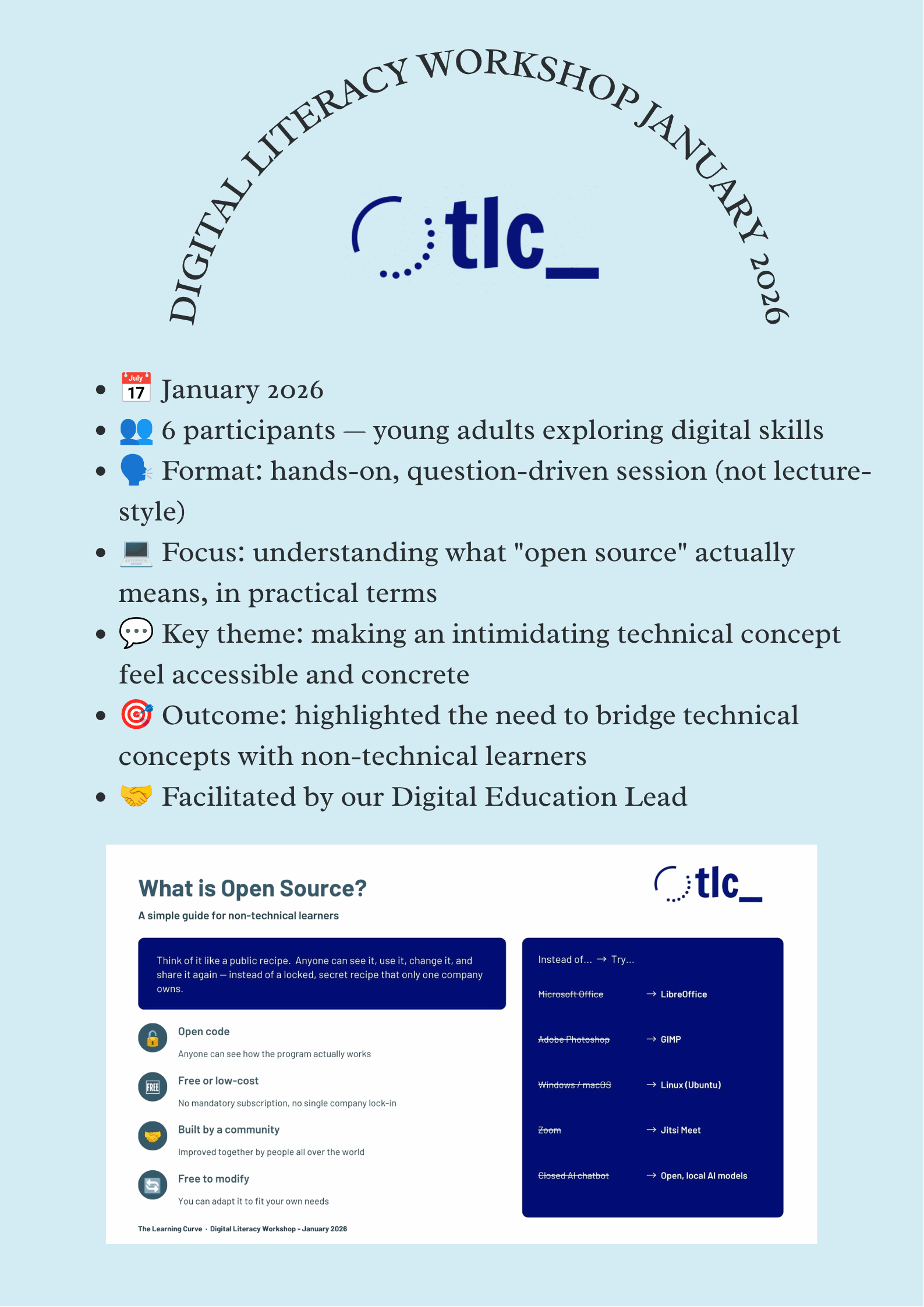
As part of our “Digital Literacy” pilot, we held a workshop in January 2026, facilitated by our Digital Education Lead.
Six young adults took part, exploring what open-source software actually means and how it compares to commercial tools they use every day. The session was designed to make an often intimidating technical concept accessible and concrete, moving from abstract definitions to hands-on, practical examples.
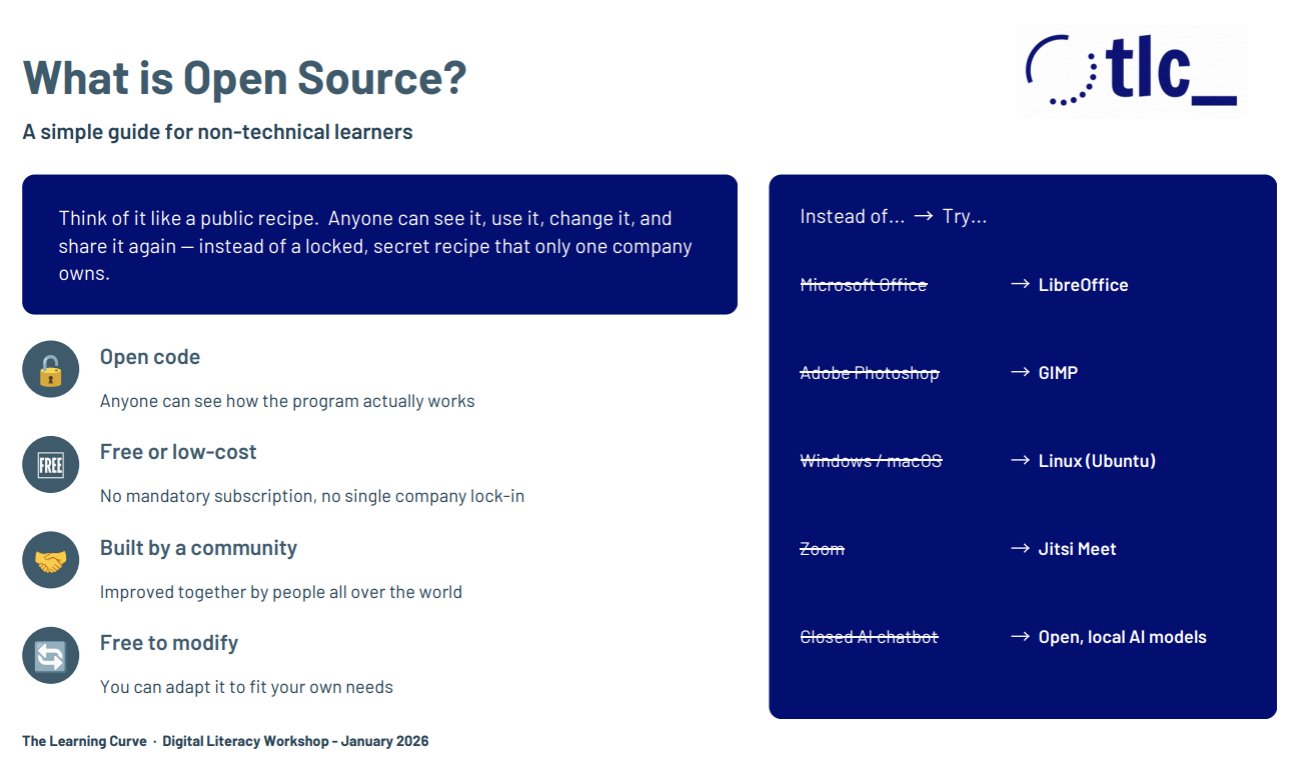
To ground the concept, we introduced it through a simple analogy: open source is like a public recipe — anyone can see it, use it, change it, and share it again, instead of a locked, secret recipe that only one company owns. From there, participants explored four key characteristics of open-source software:
- Open code: anyone can see how the program actually works
- Free or low-cost: no mandatory subscription, no single company lock-in
- Built by a community: improved together by people all over the world
- Free to modify: adaptable to your own needs
We also walked through everyday, practical examples — comparing familiar commercial tools with their open-source counterparts, such as LibreOffice instead of Microsoft Office, GIMP instead of Photoshop, and open, locally-run AI models instead of closed chatbots.
Rather than a lecture-style format, the workshop encouraged questions and experimentation, allowing participants to engage with the material at their own pace. This pilot highlighted a challenge we now aim to address more systematically: helping non-technical adults engage with technical concepts, such as open-source software and AI tools, without feeling overwhelmed.
Important note: Participant details are kept confidential in line with our data protection practices.